The short answer
Hair loss is not one problem.
It can be normal shedding, sudden excessive shedding, gradual pattern thinning, patchy loss, breakage from hair practices, traction from tight styles, scalp inflammation, infection, medication effect, hormone signal, nutrient problem, autoimmune disease, or scarring hair loss.
That is why the first good question is not "Which product should I buy?"
The first good question is:
What pattern am I seeing, how fast did it start, what else changed in my body, and what is happening on the scalp?
If the change is gradual, painless, and matches a family pattern, the next step may be planned, non-urgent care and evidence-based treatment discussion. If the loss is sudden, patchy, painful, inflamed, scaly, pus-filled, scarring, happening in a child, happening during pregnancy or breastfeeding, or linked with a new medicine or major health change, treat it as a care-first issue.
What this guide is and is not
This guide is for adults who are trying to understand hair shedding, thinning, patches, breakage, or scalp symptoms without being pushed straight into oils, gummies, shampoos, devices, or influencer protocols.
It is not a diagnosis. It is not a treatment plan. It is not pediatric advice. It is not pregnancy care. It is not a transplant consultation. It is not a replacement for a dermatologist, primary-care clinician, gynecologist, endocrinologist, or mental-health professional when the situation calls for one.
The goal is practical:
- Notice the pattern.
- Separate common explanations from care-first signals.
- Know what information to bring to an appointment.
- Avoid products that blur the line between cosmetic hope and medical claims.
- Understand why some hair loss can improve and some needs early care.
Hair loss can feel intensely personal. It changes mirrors, photographs, confidence, identity, culture, gender expression, dating, aging, and how safe a person feels in public. That emotional weight is real. But fear is also exactly what low-quality product marketing uses. The Healthopathy answer is not panic. It is structure.
Start with the pattern
The pattern tells you which doorway you are standing in.
Do not start by naming a disease. Start by describing what you can actually see.
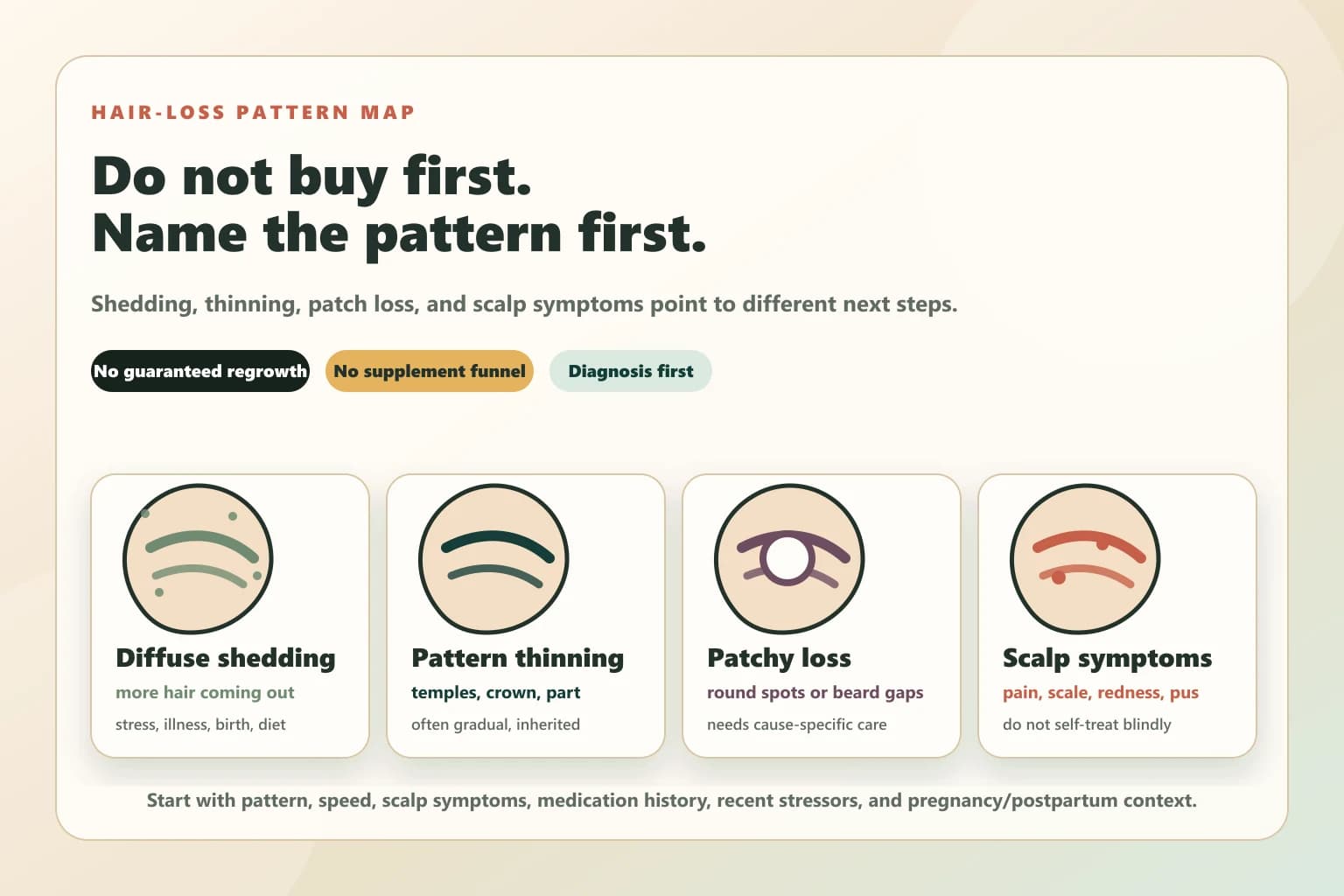
Hair-loss patterns that change the next step
| What you notice | What it may suggest | Next useful move |
|---|---|---|
| More hair in the shower, brush, pillow, or drain without clear bald patches. | Excessive shedding can happen after childbirth, illness, surgery, major stress, weight loss, or other body stressors. | Build a timeline. If shedding is heavy, persistent, unexplained, or paired with symptoms, seek care. |
| Gradual thinning on the crown, widening part, or receding hairline. | Pattern hair loss is common, especially with family history and age, but other causes can overlap. | Consider routine medical or dermatology review before long-term treatment, especially for women or sudden change. |
| Round or irregular bald patches. | Patchy loss can involve autoimmune, fungal, inflammatory, or scarring conditions. | Do not delay care, especially if patches grow, itch, hurt, scale, or affect eyebrows, beard, or body hair. |
| Short broken hairs, frizzed ends, thinning after chemical processing, heat, brushing, or tight styling. | Breakage, traction, or hair-shaft damage can mimic hair loss. | Pause damaging practices and assess scalp tension, but seek care if the scalp is painful or thinning persists. |
| Pain, burning, tenderness, redness, scaling, crusting, pus, sores, or shiny scar-like areas. | Scalp inflammation, infection, psoriasis, folliculitis, or scarring hair loss may be present. | Care comes first. Some scarring conditions can permanently damage follicles. |
Common causes by clue
A good hair-loss page should not pretend every reader has the same problem.
The same person can also have more than one contributor at the same time. Someone may have pattern thinning plus recent shedding after illness. Someone may have traction loss at the edges plus low iron. Someone may have scalp inflammation plus aggressive hair practices. Someone may have PCOS-related hormone context plus crash dieting.
That is why "try this serum" is usually the wrong first sentence.
Common causes and the clue pattern
| Claim | Evidence | Practical meaning | Caution |
|---|---|---|---|
| Daily shedding can be normal | Medical references commonly describe daily shedding as normal, with around 50 to 100 hairs per day often used as a general range. | Look for a clear change from your baseline rather than counting every hair. | Visible thinning, patches, scalp symptoms, or sudden heavy shedding should not be brushed off as normal. |
| Excessive shedding often follows a body stressor | AAD describes excessive shedding after triggers such as childbirth, significant weight loss, illness recovery, surgery, or major stress. | Write down events from the last 2 to 4 months: illness, fever, birth, surgery, crash dieting, bereavement, intense stress, or new medicines. | Shedding can improve, but persistent or unexplained shedding still needs evaluation. |
| Pattern hair loss is common but still deserves context | AAD lists hereditary hair loss and age among common causes, with gradual thinning or a changing hairline as possible signs. | Family history and slow change matter, but sex, age, medications, hormones, and scalp symptoms still change the plan. | Do not assume every widening part, crown change, or receding hairline has one simple cause. |
| Patchy hair loss needs a different mindset | AAD lists alopecia areata, infections, scarring alopecia, and other causes that can present with patches or bald areas. | Patchy loss is a reason to document photos and seek care rather than cycling through cosmetics. | Fast patch expansion, pain, scale, broken hairs, pus, or eyebrow/beard involvement increases the need for review. |
| Hair practices can cause real hair loss | AAD includes damaging hair care, tight hairstyles, and traction among hair-loss causes. | Review tight braids, buns, extensions, weaves, chemical relaxers, bleaching, heat, brushing, and tension at the edges. | Long-term traction can become scarring. Pain is not the price of a hairstyle. |
| Medical and nutrition causes can sit underneath | MedlinePlus and AAD list thyroid disease, diabetes, lupus, PCOS or hormonal imbalance, medicines, low protein, low iron, low zinc, and other health factors. | A clinician may need labs or medication review when the story does not fit a simple cosmetic explanation. | Do not self-prescribe high-dose supplements without testing or medical context. |
Care-first signs
Some hair loss can be watched briefly with a clear plan. Some should not.
The goal is not to scare people into appointments for every loose hair. The goal is to stop people from wasting months on products when the scalp or body is asking for proper care.
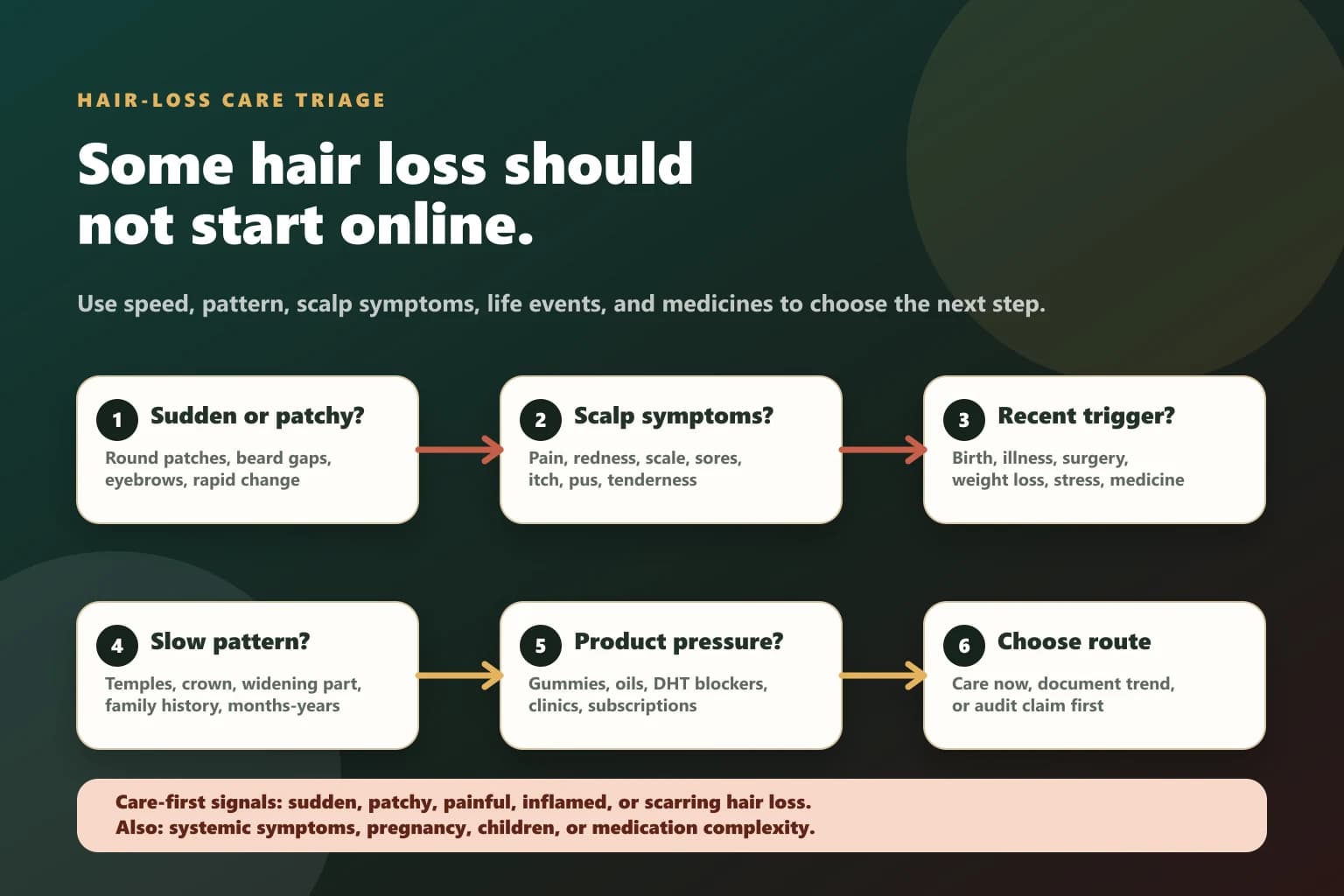
When to seek care instead of starting with products
| Signal | Why it matters | Care route |
|---|---|---|
| Sudden heavy shedding or clumps | Can follow stressors, illness, childbirth, medicines, or other medical triggers. | Primary care or dermatology, especially if persistent, unexplained, or severe. |
| Round patches, rapidly expanding bald spots, eyebrow or beard patches | Patchy loss can involve autoimmune, infection, or inflammatory causes. | Dermatology review is preferred when available. |
| Pain, burning, itching, tenderness, scale, sores, pus, crusting, or redness | Inflammation and infection can damage the scalp and sometimes the follicle. | Seek medical care before oils, acids, harsh shampoos, or devices. |
| Shiny scar-like areas, loss of follicle openings, or edge thinning with pain | Scarring hair loss and traction damage can become permanent. | Dermatology care should not be delayed. |
| Hair loss with fatigue, cold intolerance, irregular periods, acne, excess facial hair, weight change, fever, joint pain, or other systemic symptoms | The hair change may be one part of a larger medical pattern. | Primary care, gynecology, endocrinology, or dermatology depending on the symptoms. |
| Hair loss in a child, during pregnancy or breastfeeding, or with complex medicines | Diagnosis and product safety are different in these situations. | Use clinician-guided care. |
What care may check
A serious clinician does not only glance at the scalp and name a product.
The workup starts with the story:
- When did it start?
- Was the change sudden or gradual?
- Is it shedding, thinning, patches, breakage, or scalp symptoms?
- Are there photos from before?
- Any recent fever, infection, COVID-like illness, surgery, childbirth, major stress, rapid weight change, fasting, restrictive eating, or new exercise extremes?
- Any new prescription medicines, over-the-counter products, hormones, supplements, steroids, acne treatments, antidepressants, blood pressure medicines, chemotherapy, or weight-loss medicines?
- Any family history of pattern hair loss?
- Any irregular periods, acne, excess facial hair, fertility concerns, menopause transition, thyroid symptoms, autoimmune disease, diabetes, lupus, anemia, or gut disease?
- What hair practices are used: tight styles, extensions, relaxers, bleach, heat, oils, scalp acids, brushes, helmets, coverings, or workplace friction?
The exam may include the scalp, hair shaft, nails, eyebrows, beard area, body hair, and skin. Depending on the story, a clinician may do a pull test, look more closely with magnification, order blood tests, check for infection, or take a scalp sample.
Treatments and products without the hype
Treatment depends on the cause.
That sentence is boring. It is also the sentence that protects the reader.
If hair loss followed childbirth, illness, surgery, major stress, or rapid weight loss, the plan may focus on time, recovery, nutrition, and checking for underlying contributors. If the issue is pattern hair loss, evidence-based options may be discussed. If there is scalp inflammation, infection, psoriasis, alopecia areata, or scarring disease, the treatment lane changes completely. If traction or chemical damage is part of the problem, removing the cause matters.
The product market collapses all of that into one promise: regrow hair.
Healthopathy does not.
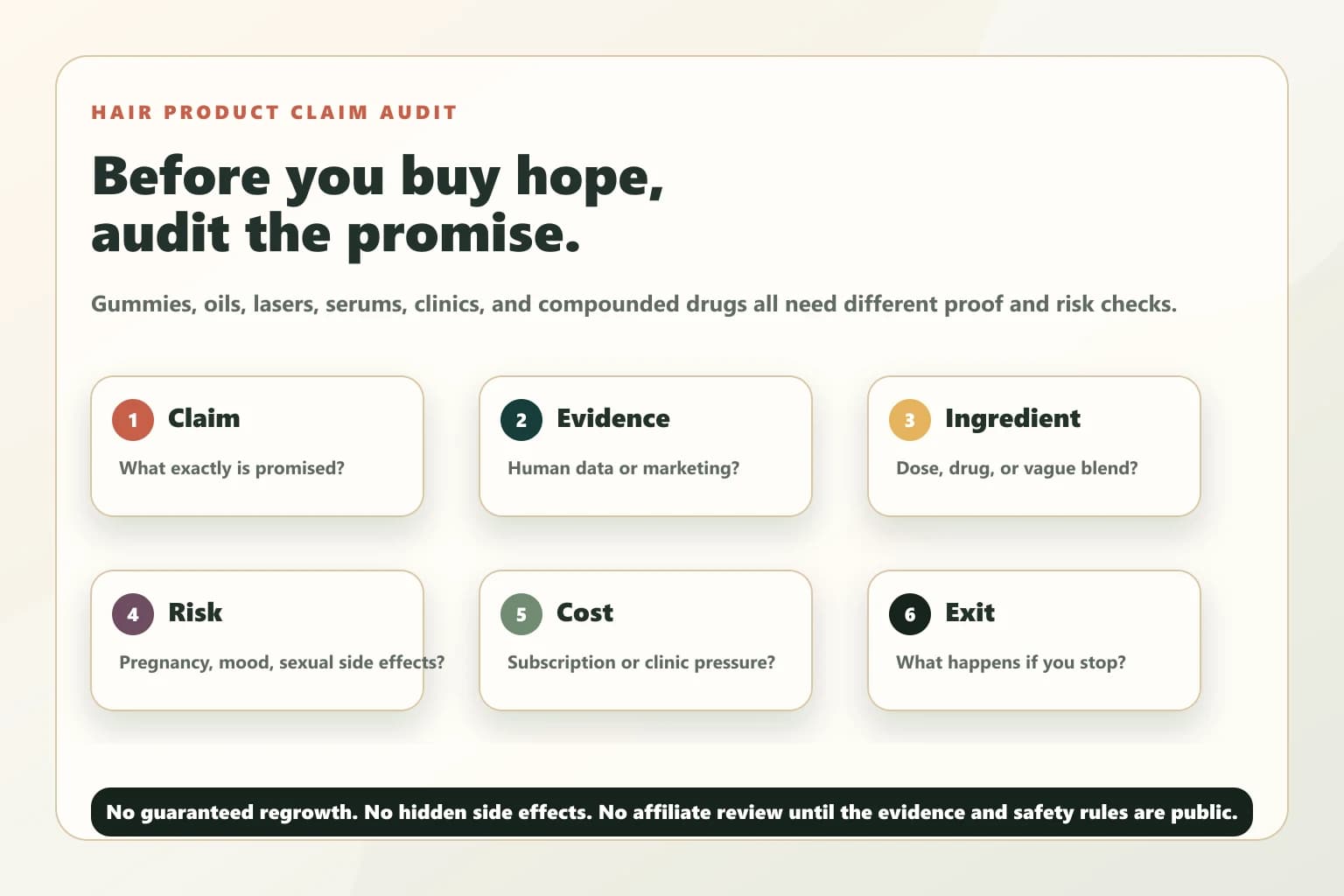
Hair-growth product claim audit
| Product or claim | What to ask before trusting it | Safety boundary |
|---|---|---|
| Minoxidil | Does my pattern match the product label, and am I willing to use it consistently for months? | Do not use as a shortcut for sudden, patchy, unexplained, painful, inflamed, under-18, childbirth-related, or non-scalp hair loss. Ask a doctor first if you have heart disease. |
| Topical finasteride | Is this FDA-approved, or is it compounded? What risks, transfer issues, pregnancy concerns, and sexual or mood side effects have been discussed? | The FDA has warned about compounded topical finasteride reports and notes there is no FDA-approved topical finasteride product. |
| Hair gummies and supplements | Do I have a tested deficiency or a real dietary gap? | More biotin, zinc, iron, or herbal blends is not automatically better and can interfere with testing or cause harm. |
| Oils, shampoos, scalp serums | Is the claim cosmetic, dandruff-related, or true hair regrowth? | Do not put irritants on a painful, inflamed, infected, or scaly scalp without care. |
| Lasers, microneedling, PRP, transplants, and devices | What diagnosis are we treating, what evidence supports it, who performs it, and what are the risks and maintenance demands? | Procedures should follow diagnosis, not replace it. |
Special contexts
After childbirth, illness, surgery, weight loss, or major stress
Shedding can increase after the body goes through a major stressor. That does not mean nothing matters. It means the timeline matters.
If the shedding is heavy, prolonged, distressing, or paired with fatigue, dizziness, irregular bleeding, restrictive eating, depression, fever, or other symptoms, get care. The answer may include reassurance, but it may also include checking iron status, thyroid context, nutrition, medicines, or other causes.
Women with widening part, acne, irregular periods, or excess facial hair
Do not reduce this to "female hair loss" and sell shampoo.
Hormonal patterns, PCOS context, iron deficiency, thyroid disease, menopause transition, medicines, autoimmune disease, traction, and pattern hair loss can overlap. Women also often lose time because early thinning is dismissed until it becomes emotionally and cosmetically harder.
Care should be practical and respectful: pattern, labs when appropriate, scalp exam, medication review, reproductive context, and treatment options with pregnancy safety boundaries.
Men with receding hairline or crown thinning
Many men have gradual pattern thinning. That does not mean the only question is "finasteride or no finasteride?"
Men still need a clean history: speed, patches, scalp symptoms, medicines, steroids, crash dieting, illness, family history, sexual-health concerns, mood history, fertility plans, and risk tolerance. Treatment decisions should include benefits, side effects, timeline, cost, and what happens if the treatment stops.
Tight styles, cultural hair practices, and traction
Hair practices are not vanity details. They can be central to diagnosis.
Tight braids, buns, ponytails, loc maintenance, extensions, weaves, head coverings, helmets, chemical relaxers, bleach, heat, brushing, and edge tension can all matter. The care conversation should respect culture while still naming risk. Pain, bumps, edge thinning, or relief when a style is removed are not normal background noise.
Children and adolescents
Hair loss in a child or teenager should not be treated like adult cosmetic thinning. Ringworm, alopecia areata, traction, pulling, nutritional issues, medicines, autoimmune disease, and emotional stress all need appropriate care. Do not use adult hair-growth medicines on a child unless a clinician specifically directs it.
Appointment prep
If you are going to seek care, make the appointment easier.
You do not need a perfect folder. You need a clean story.
Bring this to a hair-loss appointment
| Bring or prepare | Why it helps | Example |
|---|---|---|
| Timeline | Speed and trigger timing can separate shedding from ongoing hair-loss conditions. | Started 8 weeks after fever, or slowly widening part for 2 years. |
| Photos | Images make change easier to judge than memory. | Same lighting, same angle, hair parted the same way every 2 to 4 weeks. |
| Medication and supplement list | Medicines and supplements can contribute to hair loss or affect treatment safety. | Prescriptions, hormones, weight-loss drugs, acne drugs, antidepressants, steroids, vitamins, herbs. |
| Hair-care history | Tension, chemicals, heat, and scalp products can be the cause or a worsening factor. | Styles, extensions, relaxers, bleach, heat, oils, acids, shampoos, devices. |
| Symptoms beyond hair | Hair loss may be one clue in a larger health pattern. | Fatigue, cold intolerance, heavy periods, irregular cycles, acne, excess facial hair, joint pain, fever, itch, pain. |
| What you already tried | Avoids repeated mistakes and helps spot irritation or side effects. | Minoxidil, oils, supplements, prescription products, online compounds, procedures. |
The bottom line
Hair loss deserves better than panic marketing.
Start with the pattern. Ask how fast it changed. Look at the scalp. Check the body context. Review medicines and supplements. Be honest about hair practices. Treat sudden, patchy, painful, inflamed, scarring, systemic, pregnancy, child, and medication-complexity cases as care-first.
Then, and only then, talk about products.
If Healthopathy later reviews hair-growth products, the standard must be strict: diagnosis first, evidence second, safety third, expectations fourth, cost and maintenance fifth. Anything else is just selling fear with nicer packaging.
Related Healthopathy starting points: