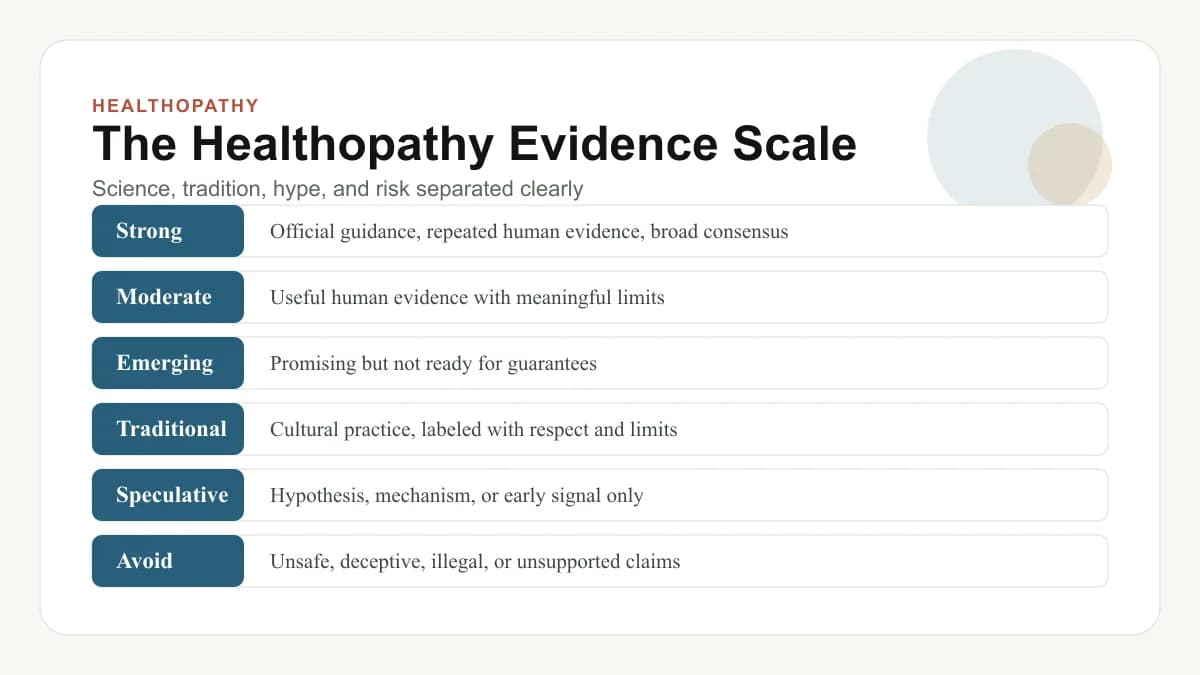
Why Healthopathy needs an evidence scale
Longevity and sexual health are two of the easiest areas of health to corrupt with hype. They sit close to fear, identity, aging, attractiveness, fertility, performance, shame, money, and hope. That makes them commercially powerful and editorially dangerous.
The Healthopathy Evidence Scale exists to slow the reader down before a claim becomes a belief. It separates what is well supported from what is promising, traditional, speculative, or not worth touching. The point is not to make every article sound cautious and lifeless. The point is to make confidence match the evidence.
Health information is not all the same. A public-health recommendation that has been repeated across large human evidence and clinical consensus should not sit in the same mental bucket as a supplement claim based on a cell study, a single small trial, a podcast anecdote, or a centuries-old practice. All of those may be worth discussing. They should not be discussed with the same certainty.
This scale is also a business guardrail. Healthopathy may later sell ebooks, paid guides, product reviews, affiliate recommendations, trackers, and courses. That creates an incentive to sound more certain than the science allows. The Evidence Scale is designed to stop that before it starts.
The six evidence labels
Healthopathy uses six labels. These are not academic grades. They are reader-facing labels that explain how much confidence a reasonable person should place in a claim before acting on it.
Healthopathy evidence labels
| Claim | Evidence | Practical meaning | Caution |
|---|---|---|---|
| Strong | Official public-health guidance, repeated human evidence, broad clinical consensus, or multiple high-quality human studies pointing in the same direction. | Can usually guide everyday behavior for most adults when adapted to personal health status. | Still needs individual medical context for pregnancy, chronic disease, medications, disability, injury, or symptoms. |
| Moderate | Useful human evidence with meaningful limits: smaller trials, mixed results, indirect outcomes, or strong observational patterns without full certainty. | May guide low-risk choices, especially when the downside is small and the practice supports broader health foundations. | Should not be sold as guaranteed treatment, disease prevention, sexual performance enhancement, or lifespan extension. |
| Emerging | Early human research, plausible mechanisms, or new study areas where the signal is interesting but not settled. | Worth watching or discussing, but not a foundation and not a promise. | High risk of exaggeration. Needs clear language about uncertainty. |
| Traditional | Long-standing cultural, spiritual, dietary, movement, or healing practice with historical use but incomplete modern clinical evidence. | Can be covered respectfully as cultural knowledge, ritual, habit, or context. | Tradition is not proof of safety or clinical effectiveness. Interactions and contraindications still matter. |
| Speculative | Hypothesis, mechanistic theory, animal or cell research, influencer interpretation, or extrapolation from unrelated data. | Useful for curiosity and future research, not for confident protocols. | Must not be framed as proven human benefit. |
| Avoid | Unsafe, deceptive, illegal, clearly unsupported, medically risky, or designed to exploit fear, shame, urgency, or sexual insecurity. | Do not recommend. Explain the risk plainly. | Especially important for supplements, hormones, peptides, unregulated sexual performance products, extreme fasting, and disease-treatment claims. |
The scale is not meant to make content boring. It is meant to make strong claims stronger by removing the weak claims around them.
How to judge a health claim
A health claim should be judged by the question it is asking. "Does walking improve cardiovascular health markers?" is not the same as "Does this supplement extend human lifespan?" The first claim can draw on a large public-health base. The second requires extraordinary proof and should be treated with suspicion unless the evidence is unusually strong.
Healthopathy uses five practical filters:
- What is the actual claim?
- What type of evidence supports it?
- Is the evidence in humans, animals, cells, or theory?
- What outcome was measured?
- What could go wrong if a reader acts on it?
The outcome question matters more than most wellness content admits. A study may show a change in a biomarker without showing longer life, lower disease risk, better sexual function, less pain, or improved quality of life. Biomarkers can be useful, but they are not magic receipts.
The same logic applies to sexual health. A product may increase blood flow in a narrow lab measure, but that does not automatically mean it treats erectile dysfunction, improves desire, reduces pain, restores fertility, or makes relationships safer. Sexual health outcomes are physical, emotional, relational, and social.
Source hierarchy
Healthopathy does not treat all sources equally. A government health page is not perfect, but it often reflects a conservative synthesis of public-health evidence. A systematic review can be useful, but only if it includes relevant studies and interprets them honestly. A randomized trial can be powerful, but a small, short, biased, or industry-funded trial is not automatically decisive.
Source hierarchy used by Healthopathy
| Source type | How Healthopathy uses it | Common mistake |
|---|---|---|
| Official public-health and clinical guidance | Used for foundational advice, safety boundaries, and broad population guidance. | Treating it as the only source or ignoring individual medical context. |
| Systematic reviews and meta-analyses | Used to understand the weight of evidence across many studies. | Quoting the conclusion without checking study quality, heterogeneity, or relevance. |
| Large human trials and cohort studies | Used to support claims about risk, outcomes, and practical interventions. | Confusing association with causation, especially in diet and lifestyle research. |
| Smaller human studies | Used as early or moderate evidence when limitations are clear. | Making big claims from short duration, small sample size, or surrogate outcomes. |
| Animal, cell, and mechanistic research | Used to explain possible mechanisms or future research directions. | Jumping from mechanism to human recommendation. |
| Traditional and cultural practice | Used to understand lived wisdom, meaning, adherence, ritual, and history. | Pretending historical use proves clinical safety or effectiveness. |
Where tradition fits
Healthopathy should cover traditional practices. A global health brand that ignores traditional foodways, breath practices, herbal traditions, fasting rituals, community structures, sexual norms, postpartum practices, and elder care customs will become narrow and culturally tone-deaf.
But respectful coverage is not the same as pretending every tradition is proven medicine.
Traditional practices can matter for several reasons. They can improve adherence because they fit a person's family and identity. They can carry meaning, ritual, and community. They can preserve useful food patterns or movement habits. They can also cause harm when a practice is unsafe, contaminated, coercive, medically inappropriate, or used instead of needed care.
Healthopathy's rule is simple: describe tradition accurately, explain the cultural context, identify what modern evidence does and does not show, and add safety boundaries. A traditional label is not an insult. It is an honest category.
This matters in sexual health too. Norms around modesty, marriage, menstruation, masculinity, fertility, menopause, contraception, desire, consent, and pleasure vary widely. Healthopathy should not flatten the world into one Western wellness voice. It should also not protect harmful practices from criticism just because they are old.
Commercial claims need a higher bar
The moment Healthopathy recommends a product, the evidence bar rises. A free article about walking can be useful with broad public-health support. An affiliate review of a supplement that claims to improve sexual performance, hormones, sleep, fertility, or aging biology needs stricter scrutiny because money changes the incentive.
Healthopathy product content should ask:
- Is there human evidence for this exact ingredient, dose, form, and outcome?
- Was the study population similar to the reader?
- Was the result clinically meaningful or just statistically noticeable?
- Are there medication, pregnancy, fertility, liver, kidney, heart, blood pressure, bleeding, or surgery concerns?
- Is the product third-party tested when contamination is plausible?
- Is the claim really about disease treatment or sexual performance?
- Would the recommendation still stand if there were no commission?
If the answer is unclear, the article should say so.
Red flags that downgrade a claim
Some claims should lose trust before the reader even reaches the source list. The wording itself can reveal the problem.
Be skeptical when a claim uses urgency instead of evidence: "do this before it is banned," "doctors hate this," "ancient secret," "one weird trick," "melts fat," "restores hormones," "reverses aging," "guaranteed results," or "works for everyone." These phrases are not automatically false, but they usually signal marketing pressure rather than careful health education.
Also be skeptical when the claim hides the comparison. "Clinically tested" does not tell the reader whether a product beat placebo, whether the result was meaningful, whether the trial was registered, whether the dose matches the product, or whether the outcome matters to real life. "Shown to increase testosterone" does not explain whether the increase was large enough to matter, whether symptoms improved, whether safety was tracked, or whether the study involved the same population as the reader.
Claim red flags
| Red flag | Why it weakens trust | Healthopathy response |
|---|---|---|
| Only animal or cell evidence for a human promise | Mechanisms can fail when tested in people. | Label speculative unless human outcomes exist. |
| Before-and-after testimonials | Anecdotes can reflect placebo effects, regression to the mean, selection, or other behavior changes. | Use as lived experience only, never proof. |
| No dose, duration, or population | Readers cannot know whether the claim applies to them. | Require details or lower the evidence label. |
| Disease-treatment language for a supplement | May cross medical and regulatory boundaries. | Require legal and clinical review before publication. |
| Sexual performance guarantee | Exploits insecurity and ignores medical causes. | Use avoid unless strong evidence and safety context exist. |
The red-flag test is not cynical. It protects the reader from being rushed into decisions when the claim is emotionally loaded.
How a Healthopathy article applies the scale
Every serious article should show the scale in practice, not simply display a badge near the title. A good Healthopathy article should make the evidence label visible in at least four places.
First, the introduction should tell the reader what is known, what is uncertain, and what the article will not promise. If the article is about sleep, the confidence can be high for the importance of sleep and lower for a specific supplement. If the article is about female desire, the confidence can be high that desire is multifactorial and lower for a single intervention.
Second, the body should connect major claims to nearby source notes. A source list at the bottom is useful, but it is not enough for high-stakes content. Readers should see which source supports which idea.
Third, the practical protocol should match the evidence. Strong evidence can support foundation-level advice. Emerging evidence can support cautious experimentation only when the downside is low. Speculative ideas should be explained as ideas, not assigned as routines.
Fourth, the safety note should be specific. A generic "ask your doctor" line is weak. A useful safety note names the actual groups or symptoms that need caution: pregnancy, medications, heart symptoms, eating disorder history, severe pain, bleeding, suicidal thoughts, sexual coercion, hormone therapy, fertility treatment, kidney or liver disease, and so on.
How labels change over time
Evidence labels are not permanent identity tags. They can move.
A practice may move from emerging to moderate when multiple human trials show consistent benefit. A supplement may move from moderate to avoid when safety signals appear. A traditional practice may remain traditional forever if it is meaningful and low-risk but never becomes clinically proven. A claim may stay speculative because the mechanism sounds interesting but human outcomes never arrive.
That is not weakness. That is how honest health publishing works.
How readers should use the scale
The scale is not only for editors. Readers can use it as a decision filter.
When a claim is strong, the next question is personal fit. For example, physical activity is strongly supported, but the right plan depends on pain, fitness level, disability, pregnancy, heart symptoms, time, and access. Strong evidence does not mean one-size-fits-all.
When a claim is moderate, the next question is downside. A low-risk sleep routine with moderate evidence may be worth trying. A supplement with medication interactions is different. Moderate evidence can support cautious action when the risk is low, but it should not support bold promises.
When a claim is emerging, the next question is whether waiting is wiser. A wearable metric, new biomarker, or supplement ingredient may be interesting without being necessary. Emerging science often rewards patience.
When a claim is traditional, the next question is safety and meaning. If a practice supports community, ritual, food quality, movement, or stress regulation and is low-risk, it may be valuable even without strong clinical proof. If it delays medical care or introduces harm, respect is not enough.
When a claim is speculative, the next question is who benefits from your belief. Speculation can be educational. It becomes dangerous when it is used to sell urgency.
When a claim is avoid, the next action is simple: do not buy, do not share as advice, and do not build a protocol around it.
The reader promise
The Healthopathy promise is not "we know everything." The promise is: we will tell you which bucket a claim belongs in before asking you to act on it.
Strong foundations deserve clear confidence. Movement, strength training, healthier dietary patterns, enough sleep, smoking avoidance, preventive care, and safe relationships do not need to be made trendy to matter.
Emerging science deserves curiosity without sales pressure. Geroscience, biomarkers, peptides, fasting windows, supplements, wearables, cold exposure, heat exposure, and sexual performance products can be covered, but the label has to follow the evidence.
Traditional practices deserve respect without fantasy. Cultural wisdom is part of global health. It is not a license to skip safety.
Commercial recommendations deserve skepticism. If a product review cannot survive an evidence table, it should not be published.
This is the standard Healthopathy will use as the site grows.