Start here: this is not just about sex
If you came here because something changed in your body, your desire, your relationship, or your confidence, the first thing to know is this: sexual health is not a side topic. It is part of health.
It is not only erections. It is not only libido. It is not only fertility, orgasm, contraception, sexually transmitted infections, pregnancy, menopause, or performance. Those topics matter, but they are pieces of a bigger system.
Sexual health includes the body, the nervous system, emotional safety, consent, pleasure, pain, prevention, relationship quality, culture, privacy, life stage, disability, medication effects, and the ability to get care without shame.
That is why a sexual problem can feel so confusing. A person may think, "What is wrong with me?" when the real answer might involve sleep loss, stress, blood pressure, diabetes risk, pelvic pain, an antidepressant, fear of pregnancy, past trauma, relationship tension, menopause, postpartum recovery, porn-shaped expectations, or simply not having the language to say what feels good or what does not.
This guide is not here to diagnose you. It is here to give you a better map.
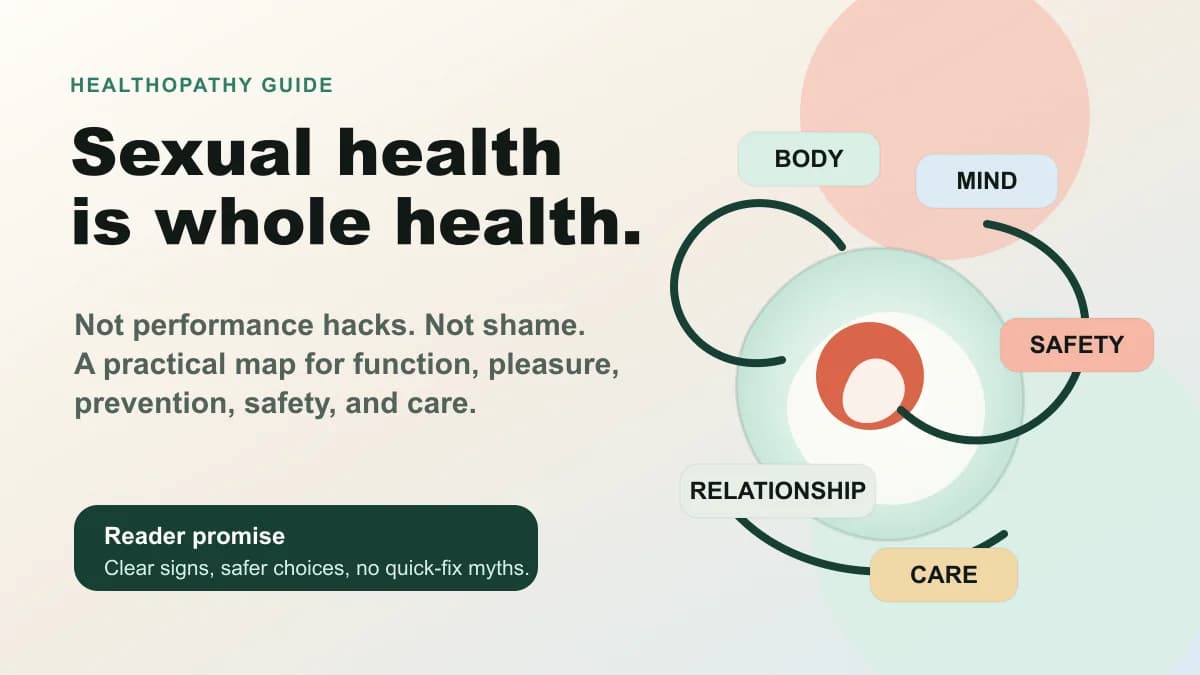
The useful map: five things to check
When sexual health feels off, most people jump to one explanation. Men may jump to testosterone or erectile performance. Women may jump to hormones, attractiveness, relationship guilt, or "maybe this is just normal." Couples may jump to blame. The internet jumps to products.
A better approach is slower and more useful. Ask about five areas.
First, body signals. Has there been pain, bleeding, dryness, numbness, erectile difficulty, orgasm changes, pelvic tension, urinary symptoms, STI exposure, fatigue, illness, medication change, pregnancy, postpartum recovery, menopause symptoms, or a new diagnosis?
Second, nervous system and mood. Are you sleeping badly? Are you anxious, depressed, burned out, grieving, dissociated, or constantly rushed? Does your body feel safe enough to want intimacy?
Third, relationship context. Is there trust? Is there resentment? Do you feel emotionally close? Can you say no without punishment? Are you carrying unequal labor, pressure, secrecy, or fear?
Fourth, prevention and practical reality. Are STI testing, contraception, pregnancy goals, condoms or barriers, vaccines, HIV prevention where relevant, and privacy being handled clearly enough?
Fifth, care access. Do you need a clinician, pelvic health specialist, therapist, STI clinic, emergency support, or simply a clearer conversation with a partner?
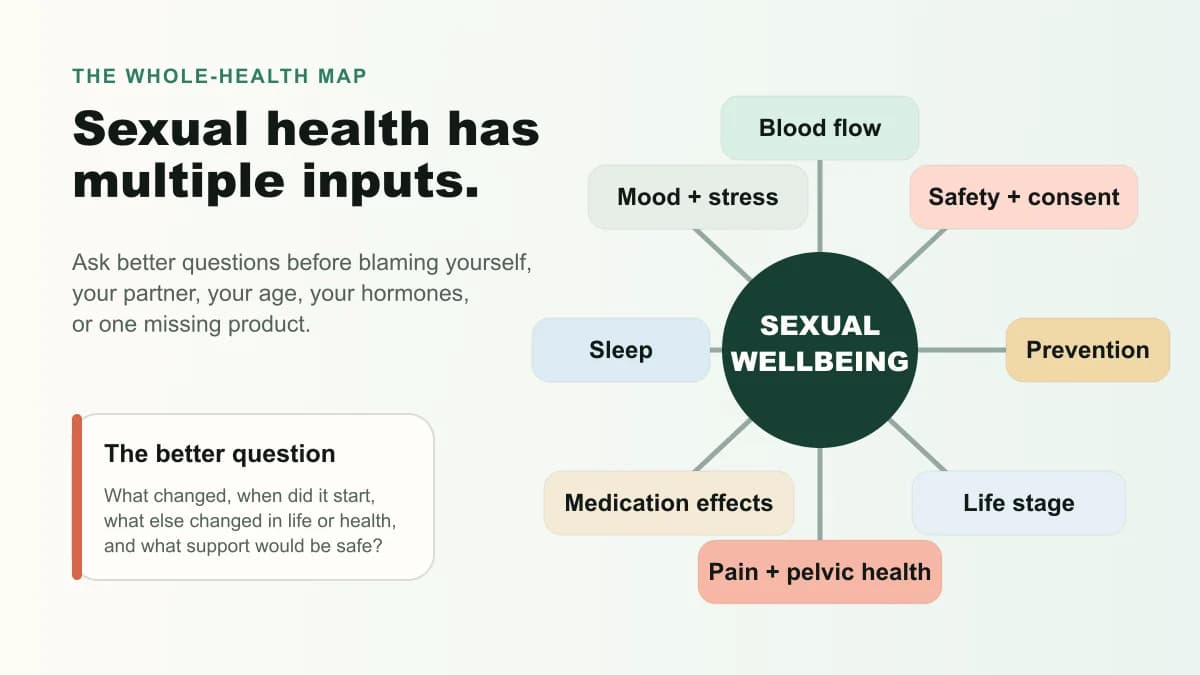
What sexual health can be connected to
| Claim | Evidence | Practical meaning | Caution |
|---|---|---|---|
| Cardiometabolic health | Blood flow, diabetes, high blood pressure, smoking, vascular disease, obesity, sleep apnea, and some medications can influence sexual function. | Persistent erectile changes or arousal changes can be useful health signals, not reasons for shame. | Chest pain, fainting, sudden severe symptoms, or major health changes need qualified care. |
| Pain and pelvic health | Pain can involve infections, dryness, pelvic floor dysfunction, endometriosis, vulvar conditions, postpartum healing, menopause, trauma, or other medical issues. | Pain is information. It is not proof that you are broken, and it is not something to push through. | Repeated pain, bleeding, infection symptoms, or fear of penetration deserve proper evaluation. |
| Mental health and safety | Anxiety, depression, trauma, stress, relationship fear, and coercion can affect desire, arousal, comfort, and sexual decision-making. | Sometimes the next step is not a technique. It is safety, support, or mental-health care. | Coercion, violence, panic, or inability to freely choose changes the priority from pleasure to safety. |
| Life stage | Puberty, pregnancy, postpartum recovery, infertility stress, perimenopause, menopause, aging, illness, disability, and grief can change sexual needs. | A change does not automatically mean decline. It may mean the body needs a different kind of care. | Generic advice often fails because it ignores life stage and medical context. |
Function matters, but performance is too small
Function means the body can do what the person wants it to do with comfort, safety, and enough reliability. That may involve erection quality, lubrication, pelvic comfort, arousal, orgasm, ejaculation, desire, fertility, sensation, energy, or the ability to be intimate without fear.
Performance is narrower. It often turns sex into a test: how hard, how wet, how often, how fast, how long, how intense, how youthful, how visually exciting, how close to a fantasy script.
That performance frame is one reason sexual-health content online feels fake. It speaks to insecurity, then sells certainty. It makes men feel like a single erection defines masculinity. It makes women feel like pain, low desire, or menopause should be hidden. It makes couples count frequency instead of asking whether intimacy feels safe, wanted, and real.
A healthier question is: what does satisfying, safe, honest sexual wellbeing look like for this body, this relationship, this age, this culture, and this medical situation?
For some people, the answer includes intercourse. For others, it includes touch, affection, masturbation, fertility planning, contraception decisions, emotional closeness, recovery from trauma, pelvic care, STI prevention, or rebuilding confidence after illness. Sexual health should make room for people who are sexually active, not currently active, single, partnered, queer, straight, disabled, older, postpartum, grieving, recovering, religious, private, curious, or cautious.
There is no universal "normal" number of times a person should want sex. The more useful marker is distress, safety, change, and fit. If desire is low but not distressing and not caused by fear, pain, coercion, or illness, it may not be a problem. If desire is high but it creates pressure, secrecy, risk, or relationship harm, it deserves attention. If two partners have different desire levels, the problem is not automatically one person. The problem is the pattern they are stuck in.
Pain is not the price of intimacy
Pain during or after sex is common enough that many people normalize it. That does not make it harmless, and it does not make it something to endure silently.
Pain may come from friction, low arousal, vaginal dryness, infections, pelvic floor tension, endometriosis, vulvodynia, skin conditions, urinary issues, bowel issues, postpartum healing, menopause-related tissue changes, trauma responses, medication effects, surgical history, or fear and muscle guarding. For some people, pain is occasional and easy to solve. For others, it becomes a cycle: pain creates fear, fear creates tension, tension increases pain, and the person starts avoiding intimacy or forcing themselves through it.
The rule is simple: repeated pain deserves respect.
That does not mean panic. It means stop treating pain as a character flaw. Do not push through pain to protect a partner's ego. Do not assume lubricant solves everything. Do not assume "it is all in your head." And do not let a clinician dismiss you without a serious history, exam when appropriate, and a plan.
Erectile changes can be health signals
Erectile difficulty is common, especially with age, stress, alcohol, sleep loss, anxiety, relationship tension, illness, and some medications. A single bad night is usually not a crisis. Persistent or sudden change deserves more attention.
The mistake is treating erectile dysfunction only as a bedroom problem. Erections depend on blood flow, nerves, hormones, mental state, sleep, medication effects, and relationship context. That is why persistent erectile changes can overlap with diabetes, high blood pressure, atherosclerosis, obesity, kidney disease, sleep apnea, low testosterone in some cases, depression, anxiety, and medication side effects.
This does not mean every erection change predicts a serious disease. It means the symptom is worth taking seriously without shame.
For many men, the hardest part is not the symptom. It is the meaning attached to the symptom: "I am less masculine," "my partner will leave," "I am aging badly," "I need a supplement tonight." That panic is profitable for bad marketers.
A better path is practical. Look at timing. Did it start after a medication, illness, injury, alcohol increase, sleep collapse, weight change, stress period, relationship conflict, porn pattern, or new health diagnosis? Is morning erection changing? Is desire present but erection unreliable? Is erection fine alone but difficult with a partner? Is there pain, curvature, numbness, urinary symptoms, chest pain, or severe anxiety?
Those details do not diagnose you, but they make the next conversation with a clinician far more useful.
Desire is not a moral score
Low desire is one of the most misunderstood sexual-health concerns. People often treat it as proof that someone is broken, selfish, unattracted, aging, hormonally defective, or not trying hard enough.
Desire is more complicated than that.
It can be affected by sleep, stress, depression, anxiety, trauma, body image, relationship conflict, pain, pregnancy, postpartum recovery, breastfeeding, menopause, chronic illness, medications, alcohol, fatigue, fertility pressure, religious guilt, privacy, resentment, caregiving load, and whether sex has become another demand.
Some desire is spontaneous: it appears before anything starts. Some desire is responsive: it appears after emotional closeness, relaxation, touch, privacy, or feeling wanted without pressure. Many people panic because they expect spontaneous desire every time, then assume something is wrong when desire needs conditions.
The practical question is not "Why am I not always in the mood?" The better question is: "What conditions help desire show up, and what conditions shut it down?"
This matters for couples. Desire mismatch is not automatically one high-desire partner versus one low-desire partner. It may be one partner seeking closeness and another protecting themselves from pressure. It may be pain. It may be resentment. It may be fear of pregnancy. It may be emotional disconnection. It may be that sex has become predictable, rushed, or focused on one person's satisfaction.
The answer is rarely shame. It is usually a more honest map.
Consent and safety come before pleasure
No sexual-health advice is trustworthy if it treats consent as a small legal footnote. Consent is the foundation.
Healthy consent is freely given, informed, specific, active, and reversible. A person can change their mind. A yes to one thing is not a yes to everything. A yes last week is not a yes today. Silence, fear, pressure, manipulation, intoxication, sleep, threats, dependency, or inability to freely choose are not a healthy basis for sexual activity.
Safety also includes emotional safety. Can you say "slow down" without punishment? Can you ask for protection without being mocked? Can you refuse sex without anger, withdrawal, guilt, or threats? Can you talk about STI testing, contraception, pain, trauma, or pleasure without being humiliated?
If the answer is no, the issue is not technique. It is safety.
Prevention is not shameful
Prevention should feel normal, not dirty. STI testing, condoms or barriers when relevant, contraception, HPV vaccination where available and appropriate, HIV prevention tools where indicated, pregnancy intention conversations, and honest partner communication are parts of mature health behavior.
The reason prevention gets awkward is that people attach meanings to it. Asking about testing can sound like accusation. Asking for protection can sound like distrust. Discussing contraception can feel unromantic. Talking about pregnancy intentions can feel too serious. But silence does not make risk disappear. It only makes people guess.
A practical prevention check-in
| Topic | Question | Why it matters |
|---|---|---|
| Testing | When were we last tested, and what tests were included? | Many STIs can be silent. Testing decisions depend on exposure, partners, anatomy, pregnancy, and local guidance. |
| Protection | What barriers, contraception, or HIV prevention tools are relevant for us? | This turns prevention into planning instead of a heat-of-the-moment argument. |
| Pregnancy intention | Are we trying, avoiding, unsure, or needing medical guidance? | People can share sex but not share the same pregnancy assumptions. |
| Symptoms | Is there pain, discharge, sores, burning, bleeding, fever, or a new change? | Symptoms deserve care. No one should be pressured to continue while worried. |
| Privacy | Are we able to seek testing or care safely and confidentially? | Privacy, laws, family pressure, cost, and stigma affect real decisions. |
When to seek care
Self-education is useful. It is not a substitute for care when symptoms are persistent, painful, sudden, frightening, or risky.
Some sexual-health concerns can be supported with better sleep, less alcohol, gentler pacing, lubricant, stress reduction, communication, safer contraception planning, or changing a routine. Others need a clinician, therapist, pelvic health specialist, emergency service, STI clinic, or crisis support.
Use this simple triage idea: urgent danger needs urgent help; repeated or concerning symptoms need qualified care; mild context-related issues may start with self-support while you watch the pattern.
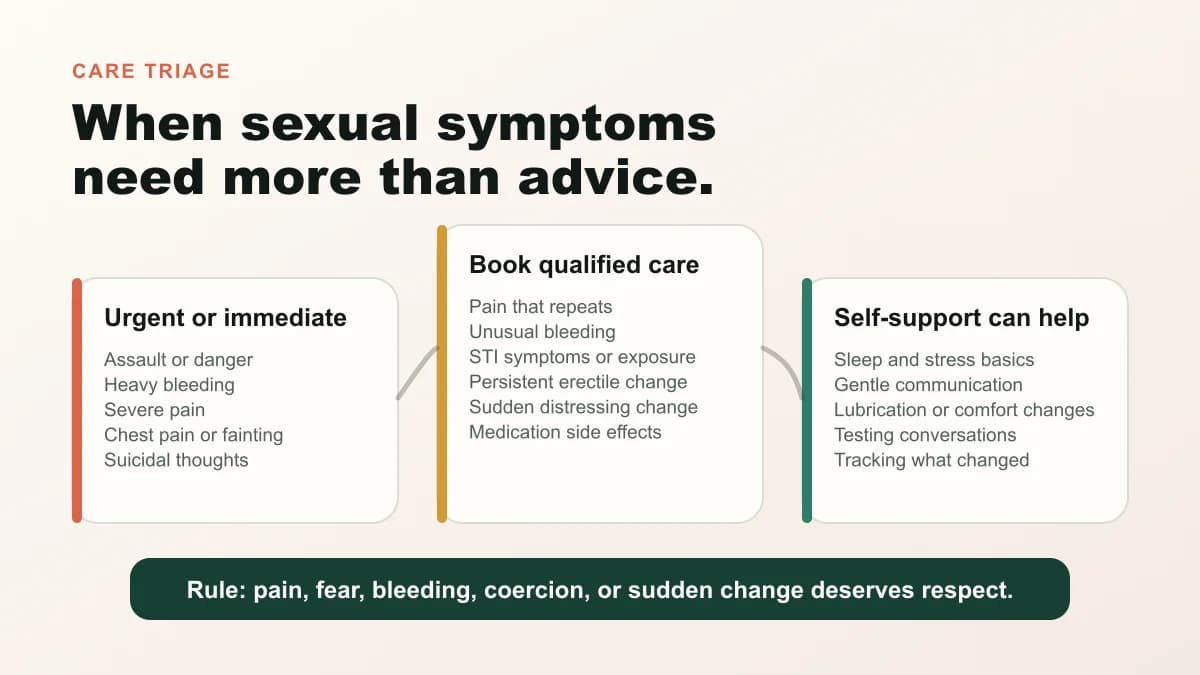
Sexual-health signals that deserve attention
| Signal | Possible meaning | Practical next step |
|---|---|---|
| Pain during or after sex | May involve friction, infection, pelvic floor tension, hormonal changes, skin conditions, trauma, endometriosis, postpartum healing, or other causes. | Stop pushing through. Seek care if pain repeats, is severe, or comes with bleeding, discharge, fever, urinary symptoms, or fear. |
| Unusual bleeding | Can have many causes, from benign irritation to infection, cervical, uterine, pregnancy-related, injury-related, or medication-related concerns. | Get medical advice, especially if persistent, heavy, painful, after menopause, or pregnancy-related. |
| Persistent erectile change | Can overlap with blood flow, diabetes risk, blood pressure, sleep, medication, hormones, stress, anxiety, or relationship factors. | Discuss with a clinician, especially if sudden, persistent, or paired with cardiovascular symptoms. |
| STI symptoms or exposure | Many infections can be silent, but symptoms or known exposure need testing and treatment guidance. | Use STI testing, treatment, partner guidance, and prevention counseling. |
| Sudden distressing desire change | May involve stress, depression, medication, hormones, pain, relationship safety, sleep, grief, or illness. | Look for context and seek medical or mental-health support if distressing or persistent. |
| Coercion, fear, or violence | This is a safety issue, not a communication problem. | Seek local emergency, crisis, medical, legal, or trusted-person support when safe. |
What better communication sounds like
Sexual communication does not need to sound like therapy jargon. It needs to be honest, specific, and kind enough to be usable.
Most people avoid these conversations because they fear embarrassment, conflict, rejection, or ruining the mood. But guessing is usually worse. Guessing turns preference into mind-reading. It turns protection into negotiation. It turns pain into silence. It turns desire mismatch into blame.
Use three kinds of sentences: preference, boundary, and care.
Preference says what helps. "I like when we slow down." "I need more time." "I feel closer when we talk first." "I want us to plan testing before we stop using barriers."
Boundary says what is not okay. "I am not comfortable with that." "I want to stop." "I do not want sex tonight." "I do not want to do this without protection." "I need to talk to a clinician before trying that."
Care protects the relationship while keeping honesty intact. "I am not rejecting you." "I want this to feel good for both of us." "Can we pause and check in?" "This is hard to say, but I trust you enough to say it."
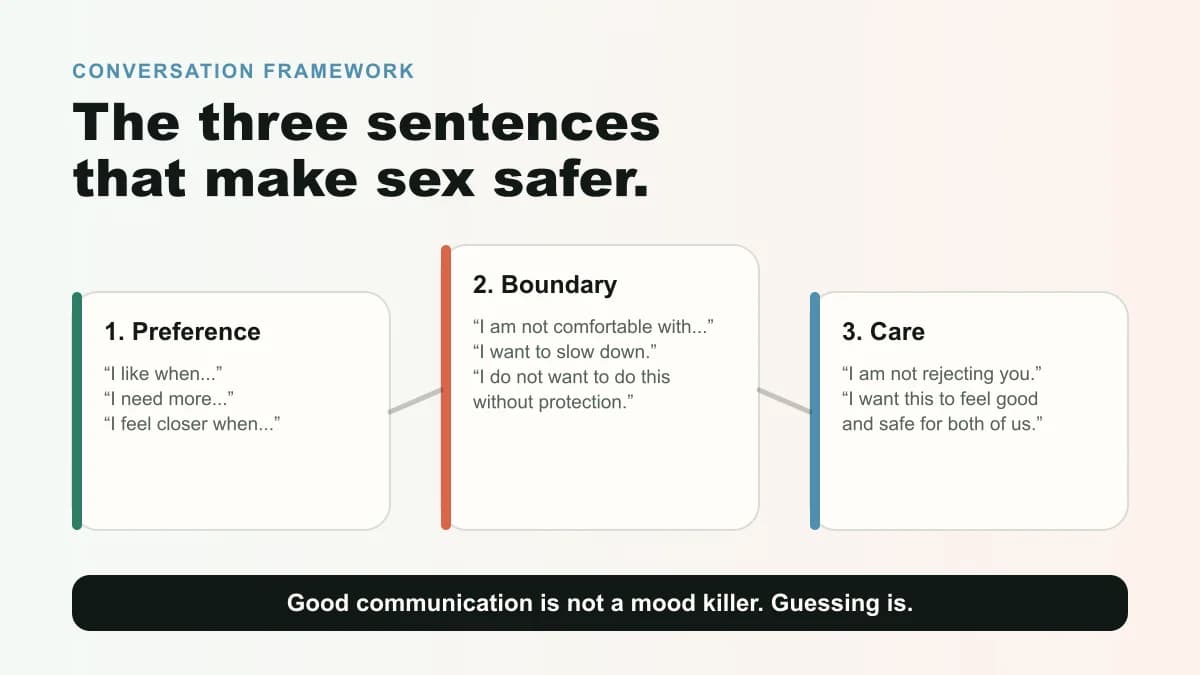
This kind of language is especially useful when something has changed. A person with erectile difficulty may need reassurance and a medical check, not jokes. A person with pain may need a pause and care, not pressure. A person with low desire may need sleep, emotional safety, and less demand, not guilt. A person with STI anxiety may need testing and facts, not shame.
Life stages change the conversation
Sexual health is not one conversation at one age. It changes across the life course.
Young people need accurate, age-appropriate education about anatomy, boundaries, consent, privacy, safety, and prevention. That education should protect them from coercion and misinformation. It should never sexualize minors.
Adults may need support with desire differences, fertility goals, contraception, STI prevention, pregnancy, postpartum recovery, stress, medications, chronic illness, pelvic pain, erectile changes, body image, and relationship repair.
Perimenopause and menopause can bring sleep disruption, mood changes, vaginal and urinary symptoms, dryness, pain, libido changes, and body-image shifts. This stage should not be framed as sexual decline. It should be treated as a real health transition with real options.
Older adults are often erased from sexual-health content, which is lazy and disrespectful. Intimacy, dating, STI prevention, erectile changes, lubrication, chronic disease, medications, grief, disability, and companionship still matter.
Life-stage lens
| Stage or context | Common sexual-health needs | What not to do |
|---|---|---|
| Young people | Age-appropriate anatomy, boundaries, consent, privacy, prevention, identity support, and protection from coercion. | Do not sexualize minors or pretend silence protects them. |
| Adult relationships | Communication, desire differences, contraception, STI prevention, fertility goals, pain, stress, medication effects, and safety. | Do not reduce relationship sex to frequency. |
| Pregnancy and postpartum | Healing, sleep loss, pain, mood, body changes, contraception, breastfeeding, pelvic floor support, and relationship adjustment. | Do not rush return-to-sex narratives. |
| Perimenopause and menopause | Vaginal and urinary symptoms, dryness, pain, sleep, mood, desire, hormones, cardiovascular risk, and body image. | Do not frame menopause as the end of sexuality or sell hormones casually. |
| Older adulthood | Intimacy, medications, chronic disease, erectile changes, lubrication, grief, dating, STI prevention, disability, and dignity. | Do not erase older adults from sexual-health education. |
Culture, privacy, and shame are part of the body
Sexual health is shaped by culture. In many families and communities, people are taught silence before they are taught anatomy. Some learn sex through fear, peers, pornography, religious guilt, marriage expectations, gender pressure, or marketing. Some cannot safely ask questions at home. Some cannot access private care. Some face stigma because of gender, sexuality, disability, infertility, divorce, contraception use, HIV status, sexual trauma, or simply wanting information.
A global sexual-health resource has to be culturally aware without becoming cowardly.
Cultural awareness means not mocking religion, marriage, modesty, family expectations, or traditional values. People are not abstract consumers; they live inside families, languages, laws, and reputations.
But cultural awareness must not excuse harm. Coercion, violence, forced sex, child marriage, denial of medical care, reproductive control, humiliation, and fear are not protected from criticism because they are familiar.
For readers, the practical point is this: if shame has made you delay care, avoid testing, tolerate pain, hide symptoms, or accept pressure, you are not alone. Shame is powerful. But health decisions made only to avoid shame often become more painful later.
Products, supplements, hormones, and quick fixes
Sexual-health commerce is one of the dirtiest parts of wellness marketing. It sells to fear: fear of not being masculine enough, not being attractive enough, not being fertile enough, not being wet enough, not lasting long enough, not being young enough, not being adventurous enough, not being "high testosterone" enough.
Some sexual-health products are legitimate. Prescription medications, contraceptives, STI treatments, vaccines, lubricants, vaginal moisturizers, pelvic-health devices, fertility tools, hormone therapies, and therapy programs can be useful in the right context.
But many products are exaggerated, under-tested, mislabeled, contaminated, or marketed with shame. Be especially skeptical of "libido boosters," "testosterone hacks," "hormone balancing" programs, erectile supplements, fertility boosters, porn-detox miracle claims, menopause cures, and anything promising guaranteed performance.
Before trusting a sexual-health product claim
| Question | Why it matters | Red flag |
|---|---|---|
| What exact outcome was studied? | Desire, pain, erection quality, fertility, orgasm, hormone level, satisfaction, and distress are different outcomes. | The product uses vague words like vitality, balance, power, or confidence without measurable results. |
| Was it tested in humans like me? | Age, sex, anatomy, diagnosis, medication use, pregnancy, menopause, and baseline health change relevance. | The evidence is animal-only, ingredient-only, or based on unrelated populations. |
| What are the risks? | Sexual-health products can interact with medications, heart conditions, pregnancy, hormones, mental health, or blood pressure. | The sales page says natural means safe. |
| Is it replacing care? | Pain, bleeding, ED, STI symptoms, trauma, and severe distress should not be hidden behind a supplement. | The product tells you doctors do not want you to know the truth. |
Hormone content deserves special care. Testosterone, estrogen, progesterone, thyroid hormones, prolactin, and other endocrine signals can matter. But hormones are not personality switches. They are part of a wider system that includes sleep, body composition, medications, mental health, pain, relationship safety, life stage, and underlying disease.
Do not let hormone anxiety become a shopping cart.
A 30-day sexual-health reset
This is not a cure. It is a structured way to stop drifting.
Week one: notice without panic. Write down what changed, when it started, what else changed in health or life, and what feels unsafe, painful, confusing, or distressing. Track sleep, stress, medication changes, alcohol, pain, desire, mood, and relationship context.
Week two: handle safety and prevention. If there is fear, coercion, violence, or pressure, prioritize support. If STI testing, contraception, pregnancy intention, or protection is unclear, make a plan. If privacy is a concern, look for safer care access.
Week three: start the conversation. Use preference, boundary, and care language. Do not try to solve everything in one talk. A good first conversation might simply name the pattern: "Something has changed, and I do not want us to handle it with shame or guessing."
Week four: decide whether care is needed. Repeated pain, unusual bleeding, STI symptoms or exposure, persistent erectile difficulty, sudden distressing desire change, medication side effects, trauma responses, fertility distress, or relationship fear deserve support. A month of tracking is not a reason to delay care when symptoms are serious. It is a way to make care more useful.
The bottom line
Sexual health is health because the body is not separate from the mind, the relationship, the culture, or the nervous system.
The goal is not to become a perfect sexual performer. The goal is to understand your body, protect your safety, reduce shame, communicate honestly, prevent avoidable harm, and get care when care is needed.
Good sexual-health content should leave a reader feeling more capable, not more defective. It should replace panic with a map.