
The short answer
Sleep is not a wellness decoration. It is one of the body systems that keeps healthspan possible.
Good sleep supports attention, memory, mood, immune function, heart health, metabolism, appetite regulation, training recovery, pain tolerance, libido, fertility decisions, relationship patience, and daily safety. Poor sleep does the opposite. It makes the rest of a health plan feel harder than it should.
For most adults, the baseline is at least 7 hours of sleep in a 24-hour period. Adults aged 61 to 64 are commonly listed at 7 to 9 hours, and adults 65 and older at 7 to 8 hours. But duration is not the whole story. Timing, consistency, sleep quality, daytime alertness, untreated sleep disorders, alcohol, caffeine, pain, shift work, caregiving, mental health, and bedroom environment all matter.
The useful question is not, "What is the perfect sleep hack?"
The useful question is, "What is preventing my body from getting enough regular, refreshing sleep, and what is the safest next step?"
Sleep is a healthspan foundation
Sleep is where the body does a lot of quiet maintenance.
During sleep, the brain processes memory and emotion, the nervous system downshifts, hormones shift, immune activity changes, appetite signals are regulated, and tissues recover from the day. Sleep also protects the next day. A tired person makes different food choices, reacts differently to stress, trains worse, craves stimulants, argues more easily, and has a higher risk of mistakes and accidents.
That is why sleep belongs beside movement, strength, food, prevention, relationships, and sexual wellbeing. It is not below them. It touches all of them.
When sleep is poor, common longevity advice can become unrealistic. "Just train harder" does not land well when someone is exhausted. "Eat better" is harder when appetite and cravings are pushed by sleep loss. "Communicate calmly" is harder when the nervous system is running hot. "Fix libido" is too narrow if the person is sleeping badly, stressed, drinking late, or waking up unrefreshed.
Sleep is not a magic cure. But it is a multiplier. Improve sleep and many other health behaviors become less heroic.
Duration, quality, timing, and regularity
Most sleep advice gets trapped in one number: 8 hours.
The better framework has four parts:
- Duration: how much sleep you get.
- Quality: whether sleep is refreshing and mostly uninterrupted.
- Timing: when sleep happens in relation to your body clock.
- Regularity: how stable the sleep and wake pattern is.
Someone can spend 8 hours in bed and still sleep poorly because alcohol fragments sleep, untreated sleep apnea interrupts breathing, pain wakes them repeatedly, anxiety keeps the brain alert, or a baby wakes every 2 hours. Someone else may sleep 7 hours and feel restored because their timing is stable and sleep is consolidated.
The goal is not worshiping a number. The goal is enough regular, refreshing sleep to function well and protect health.
The four sleep levers
| Claim | Evidence | Practical meaning | Caution |
|---|---|---|---|
| Duration | Strong guidance supports at least 7 hours for most adults, with age-specific ranges. | Estimate actual sleep, not just time in bed. Protect enough opportunity for sleep. | Some people need more than the minimum, especially with illness, training, pregnancy, or sleep debt. |
| Quality | CDC emphasizes uninterrupted and refreshing sleep, not only hours. | Repeated waking, unrefreshing sleep, or daytime sleepiness needs attention. | Poor quality can signal insomnia, sleep apnea, pain, medication effects, mood issues, or environment problems. |
| Timing | Circadian rhythm affects alertness, sleepiness, hormones, digestion, mood, and performance. | Morning light, consistent wake time, and less bright stimulation late can help align timing. | Shift work, caregiving, travel, and medical issues may make perfect timing impossible. |
| Regularity | Stable routines are a core part of public sleep guidance. | A repeatable wake time often anchors the whole system. | Do not turn regularity into shame for parents, shift workers, or people with unstable housing or care demands. |
What poor sleep does to the body
Poor sleep does not only make people tired.
Short or fragmented sleep can affect attention, reaction time, mood, hunger, cravings, blood pressure, glucose regulation, immune function, pain sensitivity, and accident risk. Over time, sleep problems are linked with cardiometabolic and mental health concerns. Untreated sleep disorders can also raise risk in ways that generic bedtime tips cannot fix.
The practical translation:
- If you are sleeping badly, your willpower is not the only issue.
- If you are hungry late at night, sleep timing may be part of it.
- If libido is low, sleep may be one piece of the puzzle.
- If training feels heavy, recovery may be underpowered.
- If mood is unstable, sleep is worth checking before judging your character.
- If you are sleepy while driving, that is a safety issue, not a productivity badge.
The sleep triage: habit problem or medical problem?
Some sleep problems are habit problems. Many are not.
This matters because a website can suggest habits, but it cannot diagnose sleep apnea, restless legs syndrome, depression, anxiety, medication side effects, chronic pain, thyroid disease, menopause symptoms, pregnancy issues, reflux, alcohol dependence, trauma, or neurological conditions.
Use this triage:
Sleep triage: what kind of problem is this?
| Pattern | Likely first step | Why it matters | Do not ignore |
|---|---|---|---|
| Not enough time in bed | Create a realistic sleep opportunity by moving bedtime, wake time, work, screens, or commitments where possible. | You cannot sleep 7 hours if life only allows 5.5 hours in bed. | Chronic restriction can still harm mood, safety, and health even if you feel used to it. |
| Trouble falling asleep | Stabilize wake time, reduce late caffeine, add wind-down, manage light, and consider CBT-I if persistent. | Insomnia often becomes a learned cycle of effort, worry, and conditioned alertness. | Long-term insomnia deserves care. Do not rely only on alcohol or sedatives. |
| Repeated waking | Check alcohol, pain, reflux, urination, stress, temperature, partner disruption, and sleep apnea signs. | Fragmented sleep can leave you tired even after enough time in bed. | Waking gasping, choking, or with witnessed pauses in breathing needs evaluation. |
| Enough hours but still exhausted | Screen for sleep quality, sleep apnea, medications, mood, anemia, thyroid, chronic disease, and life stress. | Unrefreshing sleep is not solved by simply adding more time in bed. | Severe daytime sleepiness can be dangerous for driving and work. |
| Shift work or rotating schedule | Use a harm-reduction plan around light, naps, caffeine timing, meals, and protected sleep blocks. | The problem is partly biological and partly structural, not a moral failure. | Sleepy driving after night shifts is a serious risk. |
Red flags: when sleep needs care
Sleep tips are not enough when symptoms point to a sleep disorder or another health issue.
Talk with a qualified healthcare provider if you have:
- Loud snoring with choking, gasping, or witnessed breathing pauses
- Severe daytime sleepiness
- Falling asleep while driving, working, or in unsafe situations
- Morning headaches with poor sleep
- Persistent insomnia lasting weeks or months
- Restless, crawling, or uncomfortable leg sensations that interfere with sleep
- Acting out dreams, violent movements, or sleepwalking with risk
- Waking with chest pain, severe shortness of breath, or heart symptoms
- New sleep problems after starting medication
- Sleep problems with severe depression, anxiety, trauma, or suicidal thoughts
- Pregnancy-related breathing problems, severe insomnia, or high-risk symptoms
- A child or teen with major sleep symptoms
Sleep apnea: the missed healthspan issue
Sleep apnea is not just "snoring."
It happens when breathing stops and restarts many times during sleep. Obstructive sleep apnea, the most common type, involves repeated upper-airway blockage. Central sleep apnea involves the brain not sending the right breathing signals. Either way, sleep can become fragmented and oxygen levels can drop.
Signs that deserve attention include:
- Loud snoring
- Gasping or choking during sleep
- Someone witnessing pauses in breathing
- Excessive daytime sleepiness
- Morning headaches
- Dry mouth on waking
- Trouble concentrating
- High blood pressure
- Waking unrefreshed despite enough time in bed
Sleep apnea can affect heart health, blood pressure, mood, concentration, sexual function, metabolic health, and driving safety. A person can eat well and train hard but still feel terrible if sleep apnea is untreated.
This is why Healthopathy should never turn sleep into only a bedtime routine page. Sometimes the solution is not a better pillow. Sometimes it is a sleep study and treatment.
Insomnia: why trying harder can backfire
Insomnia is not laziness. It is also not always solved by "put your phone away."
Many people with insomnia are trying very hard to sleep. That effort can become part of the problem. The bed becomes a place of performance anxiety. The clock becomes a threat. The person spends longer in bed but sleeps worse.
Long-term insomnia often responds best to structured care, especially cognitive behavioral therapy for insomnia, commonly called CBT-I. CBT-I can include sleep education, stimulus control, sleep restriction, relaxation, and changing thoughts that keep the nervous system alert.
For a reader, the takeaway is simple:
- If insomnia is occasional, sleep habits may help.
- If insomnia is persistent, do not just keep buying teas, gummies, pillows, or apps.
- If insomnia is tied to trauma, panic, depression, pain, medication, or substance use, get qualified support.
- If sleep aids are used, discuss risks, interactions, driving, falls, pregnancy, and next-day impairment with a clinician.
The first sleep reset: seven days
This reset is not a cure. It is a way to find the highest-friction point in your sleep system.
Do not change everything at once. Change the levers that matter most and collect information.
7-day sleep reset
| Day | Focus | Action | What to notice |
|---|---|---|---|
| Day 1 | Sleep audit | Write down bedtime, estimated sleep time, wake time, caffeine, alcohol, naps, exercise, and sleepiness. | Are you short on time in bed, quality, timing, or all three? |
| Day 2 | Wake anchor | Choose the most realistic wake time you can repeat for the next week. | Does one stable anchor make bedtime easier to predict? |
| Day 3 | Light | Get outdoor morning light when possible and dim bright screens or overhead light near bedtime. | Do you feel sleepier at a more predictable time? |
| Day 4 | Caffeine and alcohol | Move caffeine earlier and avoid alcohol near bedtime. | Does sleep feel less fragmented? |
| Day 5 | Bedroom friction | Make the room cooler, darker, quieter, and less stimulating where possible. | What environmental issue was easiest to fix? |
| Day 6 | Wind-down | Use a 20-minute routine: low light, hygiene, reading, prayer, breathing, stretching, music, or quiet. | Does the body get a clearer signal that the day is ending? |
| Day 7 | Care check | Review red flags: snoring, gasping, severe sleepiness, insomnia, pain, mood, medications, or safety risk. | Is this a habit problem or a care problem? |
If you learn that your real issue is a baby, night shift, pain, unsafe housing, a snoring partner, or panic at night, do not pretend a generic routine can solve the whole thing. The reset is useful because it shows reality.
The basic sleep routine
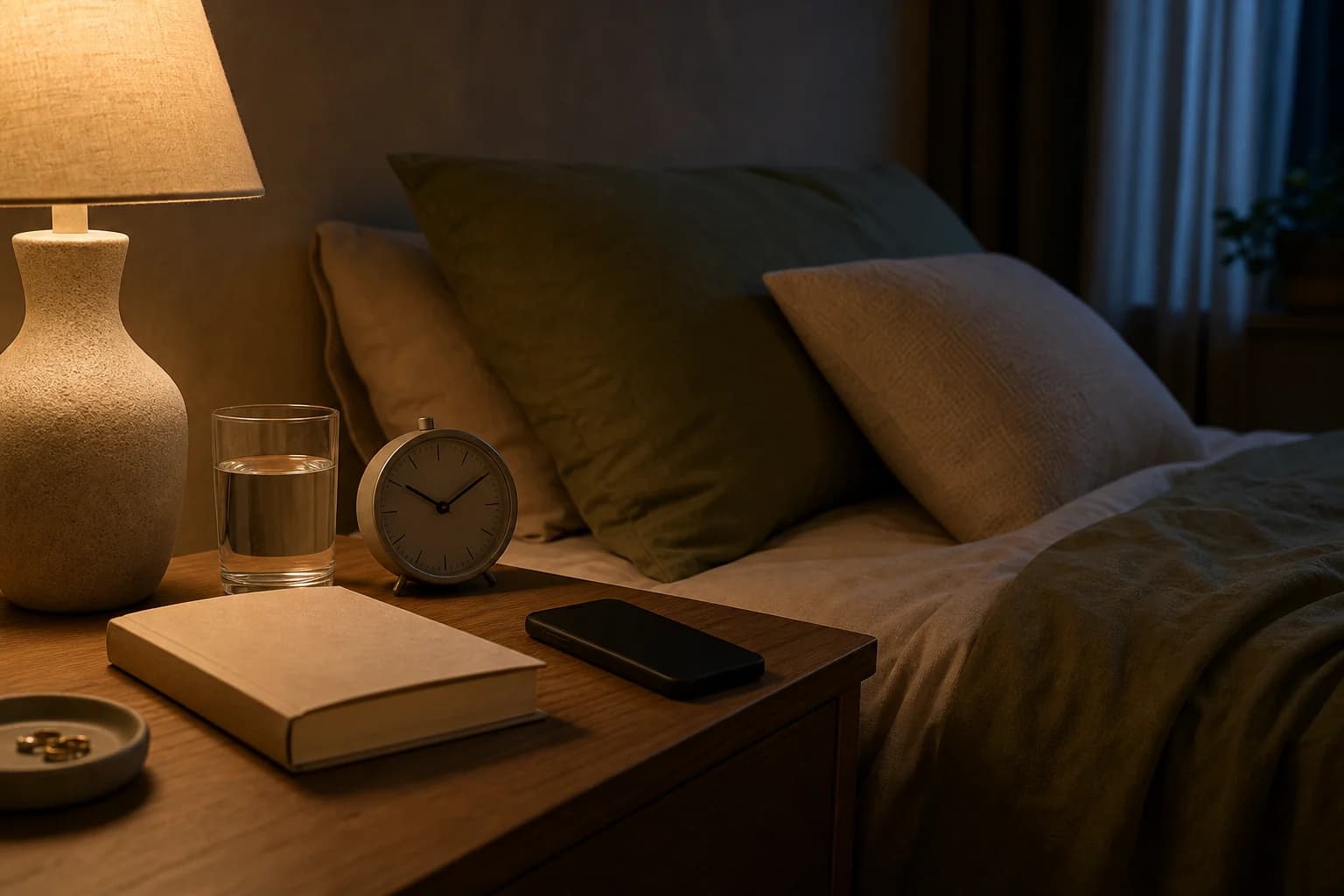
A strong sleep routine is not luxurious. It is predictable.
The goal is to give the body repeated signals:
- Morning is for light and activation.
- Daytime is for movement, meals, and work.
- Evening is for dimming intensity.
- Bed is for sleep and intimacy, not stress scrolling or work.
A practical sleep routine
| Lever | What to do | Why it helps | Common mistake |
|---|---|---|---|
| Wake time | Pick a wake time you can repeat most days. | A stable wake time anchors the body clock. | Trying to fix bedtime while wake time swings wildly. |
| Morning light | Get outdoor light soon after waking when possible. | Light helps signal daytime to the circadian system. | Staying in dim indoor light all morning. |
| Caffeine | Move caffeine earlier if it affects sleep. | Caffeine can delay sleepiness and fragment sleep for sensitive people. | Assuming caffeine is harmless because you can fall asleep. |
| Alcohol | Avoid using alcohol as a sleep tool. | Alcohol may make sleepiness feel easier but can lighten and fragment sleep. | Counting passing out as recovery. |
| Screens | Turn off or reduce stimulating devices before bed. | Light and content can keep the brain alert. | Replacing sleep with one more hour of scrolling. |
| Bedroom | Make the room quiet, dark, relaxing, and cool enough. | Environment reduces repeated wakeups. | Buying products before fixing noise, light, heat, or routine. |
Food, alcohol, caffeine, and training
Sleep is not isolated from the rest of the day.
Late caffeine can delay sleep even when a person says, "I can sleep after coffee." Alcohol can make falling asleep feel easier but reduce sleep quality. Heavy meals close to bed can worsen reflux or discomfort for some people. Training too close to bedtime can be activating for some, while daytime activity often helps sleep.
Useful defaults:
- Keep caffeine earlier, especially if sleep is fragile.
- Do not use alcohol as a sedative.
- Avoid very heavy late meals if they disturb sleep.
- Train during the day when possible.
- If evening exercise is the only option, keep it moderate and observe your response.
- Eat enough across the day; under-fueling can worsen night waking for some people.
- Hydrate, but avoid forcing large fluid intake right before bed if bathroom trips wake you.
There is no universal cut-off time that works for everyone. The test is whether your sleep improves when the lever changes.
Sleep and sexual health
Sleep belongs inside sexual health because desire, arousal, erection quality, lubrication, pain tolerance, mood, energy, hormones, and relationship patience are all affected by recovery.
Poor sleep can reduce libido directly by exhaustion and indirectly through stress, low mood, alcohol use, metabolic changes, and relationship strain. Sleep apnea can overlap with erectile problems, blood pressure, fatigue, and low morning energy. Menopause symptoms can disturb sleep through hot flashes, night sweats, mood changes, and urinary symptoms. Postpartum sleep disruption can collide with healing, desire, identity, and relationship pressure.
This does not mean sleep is the only cause of sexual changes. Pain, trauma, medications, relationship safety, hormones, infection, chronic disease, fertility stress, body image, and culture all matter too.
The mature question is:
"Is sleep one of the reasons my body does not feel safe, energized, or responsive?"
If yes, sexual health advice should include sleep instead of jumping straight to performance products.
Sleep across life stages and cultures
Sleep advice often assumes a private bedroom, quiet home, stable work hours, and control over time. Many people do not have that.
Real sleep is shaped by:
- Night shifts
- Caregiving
- Infants and children
- Menopause
- Pain
- Shared rooms
- Noise
- Heat
- Unsafe housing
- Religious practice
- Family schedules
- Long commutes
- Financial stress
- Technology use
- Social obligations
A global sleep plan has to be flexible. Some people need a nap strategy. Some need blackout curtains. Some need earplugs. Some need an honest family conversation. Some need medical treatment. Some need policy-level changes at work. Some need permission to stop treating exhaustion as virtue.
What to track without becoming obsessed
Sleep trackers can help. They can also make people anxious.
Use tracking when it changes a decision. Stop or simplify tracking when it turns sleep into a nightly exam.
Useful sleep tracking
| Claim | Evidence | Practical meaning | Caution |
|---|---|---|---|
| Sleep opportunity | Strong practical value. | Track when you got into bed and when you got out. | Time in bed is not the same as sleep time. |
| Wake time consistency | Core sleep habit lever. | Use a regular wake time as the first anchor. | Shift workers and caregivers need flexible harm reduction. |
| Daytime sleepiness | Important symptom signal. | Notice sleepiness while driving, working, reading, or sitting quietly. | Severe sleepiness deserves care, not just more motivation. |
| Snoring and breathing signs | Useful sleep apnea screen signal. | Ask a partner or use recordings if appropriate. | A consumer app does not diagnose sleep apnea. |
| Wearable sleep score | Variable accuracy depending on device and metric. | Use trends, not single-night scores. | Do not let imperfect data create sleep anxiety. |
Sleep products and supplement claims
Sleep is a massive product category because tired people are desperate.
Some products can help. A comfortable mattress, blackout curtains, a fan, earplugs, eye mask, white noise, light therapy, or CPAP supplies can be genuinely useful in the right context. But the product should solve the actual problem.
Be skeptical of:
- "Deep sleep booster" claims
- Melatonin used casually at high doses without context
- Magnesium sold as a cure-all
- CBD or sedating products with unclear dosing, interactions, or legality
- Blue-light products that ignore schedule, stress, caffeine, and alcohol
- Sleep trackers that create fear rather than better decisions
- Affiliate reviews that never tell you who should not buy the product
A 30-day sleep rebuild
This is the sleep version of a base-building plan. It is not a challenge. It is a controlled experiment.
30-day sleep rebuild
| Week | Focus | What to do | Success marker |
|---|---|---|---|
| Week 1 | Audit and wake anchor | Track sleep opportunity, wake time, caffeine, alcohol, naps, and daytime sleepiness. Pick one realistic wake time. | You know whether the main issue is duration, quality, timing, or symptoms. |
| Week 2 | Light and evening friction | Add morning light where possible. Reduce bright screens, work, heavy meals, alcohol, and late caffeine near bedtime. | Bedtime feels less like a crash landing. |
| Week 3 | Sleep environment | Improve darkness, noise, temperature, comfort, and partner or family disruptions where possible. | Night waking or bedtime resistance improves even slightly. |
| Week 4 | Care decision | Review red flags and decide whether symptoms require medical evaluation, CBT-I, a sleep study, medication review, or mental health support. | You stop treating medical sleep problems as character flaws. |
The bottom line
Sleep for longevity is not about becoming a perfect sleeper. It is about protecting the recovery system that makes every other healthspan habit easier.
Start with enough opportunity, a stable wake anchor, morning light, less late caffeine and alcohol, a calmer evening, and a better sleep environment. Track symptoms, not just scores. Do not ignore snoring, gasping, severe sleepiness, persistent insomnia, or unsafe drowsiness.
The goal is not to win sleep.
The goal is to wake with enough body and brain available for the life you are trying to build.